GeroscienceNovember 3, 20266 min read
Watch Out, That Monkey Can Spit
Marmosets, strawberry-banana yogurt, and an intriguing salivary-gland study — what aging primate tissue might tell us about rapamycin, and what it cannot yet tell us about people.
Marmosets, strawberry-banana yogurt, and an intriguing salivary-gland study — what aging primate tissue might tell us about rapamycin, and what it cannot yet tell us about people.
There is something wonderfully undignified about one of the more interesting recent experiments in primate geroscience.
It involves monkeys, rapamycin, strawberry-banana yogurt and spit.
More precisely, it involves the submandibular salivary glands of common marmosets—small New World monkeys increasingly important to aging research—and a team of scientists in San Antonio who have been quietly asking a very big question:
Can rapamycin make old primate tissue look biologically younger?
In June 2026, Parveez Ahamed Abdul-Azees and colleagues, including longtime rapamycin researcher Adam Salmon and senior investigator Chih-Ko Yeh, published an intriguing answer in Aging and Disease. The team included researchers from UT Health San Antonio's Center for Regenerative Sciences, School of Dentistry, Barshop Institute for Longevity and Aging Studies, the South Texas Veterans Health Care System and collaborating institutions.
And the answer was not simply that rapamycin changed a biomarker.
Under the microscope, the salivary glands of rapamycin-treated older marmosets more closely resembled those of younger animals.
That's worth talking about.
The common marmoset, Callithrix jacchus, weighs only a few hundred grams. Unlike our familiar laboratory mouse, however, it is a primate.
That matters.
Mice have been extraordinarily useful in aging research, but mice aren't tiny humans. Their anatomy, metabolism, immune systems and disease patterns differ from ours in important ways.
Marmosets occupy an interesting middle ground. They are primates, they age considerably faster than we do, and they develop a number of age-related abnormalities that resemble human disease. Their relatively short lifespan makes them particularly useful for longitudinal geroscience.
Their salivary glands are also particularly interesting because the architecture of the marmoset submandibular gland closely resembles that of humans.
Which brings us to the yogurt.
Years before this latest salivary-gland paper, researchers had to solve a wonderfully practical problem:
How do you give rapamycin to a monkey every morning without turning the experiment into a wrestling match?
The solution was strawberry-banana yogurt.
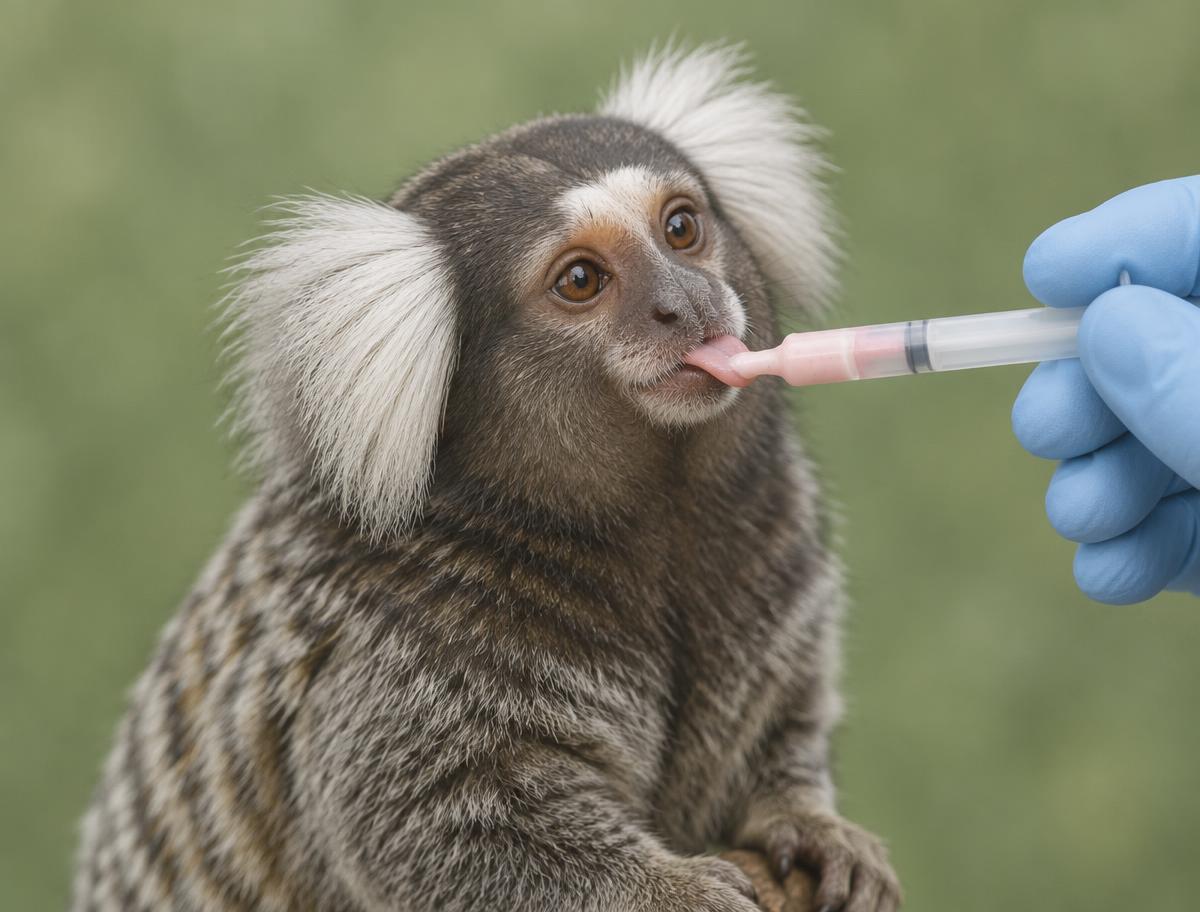
Researchers mixed Eudragit-encapsulated rapamycin into low-fat strawberry-banana yogurt and trained the marmosets to lick approximately one milliliter from a syringe.
They were remarkably methodical about it.
Fruit pieces were removed. The mixture was homogenized. It was refrigerated and protected from light. Researchers even tested the rapamycin concentration over seven days to make sure the drug remained stable in the yogurt.
The monkeys were trained progressively to approach the syringe, touch it and finally lick yogurt from it. Particularly skeptical animals could apparently be persuaded with a little marshmallow diplomacy.
Eventually the animals would voluntarily take their daily dose, eliminating the need for restraint and allowing researchers to know that each monkey actually received the intended amount.
Science is sometimes a billion-dollar particle accelerator.
Sometimes it's strawberry-banana yogurt and a monkey who has learned to trust a syringe.
The long-term animals received about 0.4 milligrams of rapamycin per day, roughly 1 mg/kg, for 14 months. Their average rapamycin blood concentration was around 5.2 ng/mL, and researchers demonstrated suppression of mTORC1 signaling. Importantly, the original work reported no evidence of anemia, mouth ulcers or fibrotic lung disease during treatment.
Those animals and the tissue collected from this program have continued to produce science years later.
Which brings us back to the spit glands.
The answer isn't especially pretty.
With age, the marmoset submandibular gland lost both mucus-producing and serous acinar units—the little secretory factories responsible for producing saliva.
The gland became progressively remodeled.
Ductal tissue expanded. Collagen-rich stromal tissue increased. Fibrosis increased. Lipid metabolism became dysregulated. Lipid accumulated in the tissue. Researchers found more apoptotic cells—cells undergoing programmed death—and more senescent cells, the metabolically altered cells increasingly implicated in age-related tissue dysfunction.
In other words, the gland didn't simply make less spit.
Its architecture was aging.
Now look at the older animals that had received rapamycin.
Their glands showed partial preservation of the acinar structures, less fibrosis, less lipid accumulation and fewer apoptotic and senescent cells.
Taken together, the investigators wrote that the tissue phenotype more closely resembled that of younger animals.
Those words deserve some restraint.
This was not proof that rapamycin “rejuvenated” an entire monkey.
It did not demonstrate that the treated animals lived longer.
The study did not establish that their salivary glands produced more saliva or that rapamycin prevents human dry mouth.
But something biologically interesting happened.
An old primate tissue exposed chronically to an mTOR inhibitor retained structural characteristics associated with youth.
That's a result worth staring at for a while.
Because salivary glands aren't just bags of water.
Saliva lubricates food, begins digestion, protects teeth, buffers acids, suppresses microbes and maintains the tissues of the mouth. Declining salivary function in older adults contributes to xerostomia—dry mouth—which can mean difficulty eating, swallowing and speaking, along with greater risk of dental disease and infection.
But I think this study raises an even more interesting question.
Why stop at the salivary gland?
Glands throughout the body are made of specialized secretory cells that must maintain extraordinarily active protein-production machinery for decades.
They age.
Their secretory cells disappear. Fat and fibrotic tissue invade. Mitochondria deteriorate. Senescent cells accumulate. Inflammation changes the local environment.
Consider the pancreas.
Or the prostate.
The endocrine glands.
And perhaps most intriguingly, the lacrimal glands sitting above our eyes.
Age-related dry eye is extraordinarily common.
And the aging lacrimal gland displays a remarkably familiar pathology: loss of acinar cells, increasing stromal fibrosis, mitochondrial dysfunction, oxidative stress, cellular senescence and chronic inflammatory remodeling.
Sound familiar?
There is another fascinating clue.
In aging mice, researchers have already used rapamycin experimentally in the lacrimal gland and reported improved mitochondrial quality-control signaling, reduced oxidative stress and apoptosis, preservation of acinar tissue and increased tear secretion.
A mouse is not a marmoset.
And neither is a human.
But now we have a provocative chain of observations.
Rapamycin can extend lifespan in mice.
Rapamycin can influence aging biology across numerous mammalian tissues.
And now chronic rapamycin exposure in a nonhuman primate is associated with salivary-gland tissue that looks structurally more youthful than untreated old tissue.
That doesn't answer whether rapamycin will preserve my salivary glands—or my lacrimal glands—as I grow older.
It makes me want someone to ask.
One of the things I love about geroscience is that the most interesting evidence doesn't always arrive with trumpets.
Sometimes it arrives as a survival curve.
Sometimes as walking speed.
Sometimes as immune function.
And sometimes it is hiding in a microscope slide from a tiny monkey who spent more than a year happily licking rapamycin-laced strawberry-banana yogurt from a syringe.
The important observation isn't that these monkeys could spit.
It's that one little piece of an aging primate appeared to have aged differently.
And when an intervention begins doing that across different tissues and different mammalian species, I think we should pay attention.
Especially when the monkey starts spitting.
By the author
Written with curiosity, humility, and evidence. Corrections and counter-arguments are welcome — this journal treats reader pushback as a feature, not a bug.
The Dispatch
New essays, papers worth your attention, and quiet reflections on what the rapamycin literature is — and is not — telling us. No hype. No sales.
Keep reading